THE LEVEL OF KNOWLEDGE AND ATTITUDE OF TRADITIONAL FISHERMEN IN GUAERIA TOWARDS THE RISK OF EAR BAROTRAUMA
DOI:
https://doi.org/10.31603/82maj073Keywords:
Ear Barotrauma, Knowledge, Attitude, Traditional FishermenAbstract
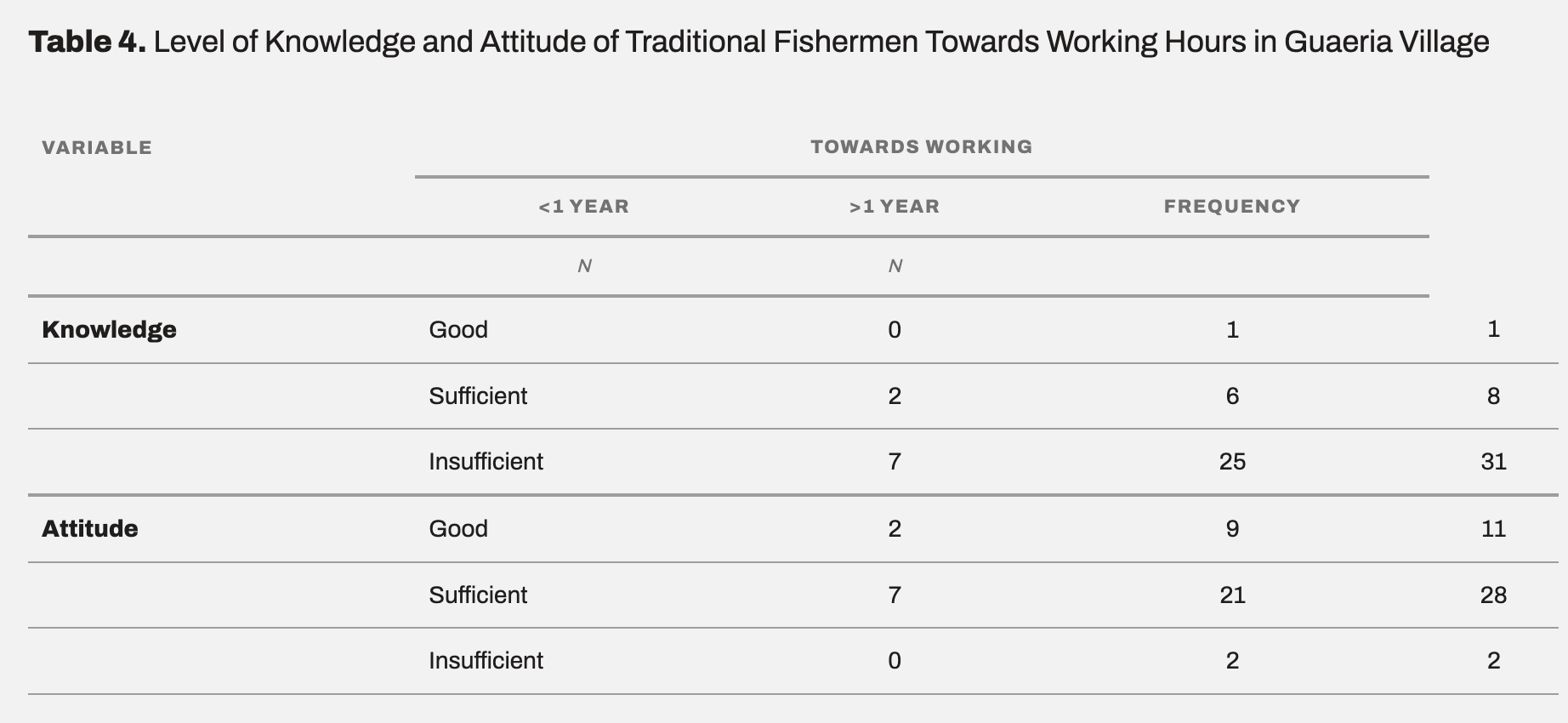
Traditional fishermen in remote coastal villages often use simple diving methods with unmonitored dive depth and duration, increasing their risk of ear barotrauma, particularly due to a lack of knowledge and formal training. This study aimed to assess the level of knowledge and attitudes toward ear barotrauma risk among traditional fishermen in Guaeria Village, Jailolo District, West Halmahera Regency, North Maluku Province. This observational study used a cross-sectional design with a total sampling technique, involving all 41 traditional fishermen in the village. Data were collected through structured interviews using a validated questionnaire and analyzed descriptively using SPSS. The results showed that most respondents were aged over 40 years (68.3%), male (100%), had worked for more than 1 year (78%), dove less than 4 days per week (61%), had a normal body mass index (73.2%), and dove for more than 30 minutes per session (70.7%). All respondents (100%) reported a history of barotrauma, with symptoms including ear pain (90.2%), dizziness (90.2%), tinnitus (73.2%), nosebleeds (58.5%), hearing loss (46.3%), and ear bleeding (36.6%). Most fishermen had insufficient knowledge (78.1%) but a sufficient attitude (68.3%) regarding barotrauma risk. In conclusion, traditional fishermen in Guaeria Village show a high prevalence of ear barotrauma symptoms; although their attitude toward barotrauma risk is fairly good, their knowledge remains insufficient, likely due to limited access to information and formal education on diving health risks.
References
Ahmad Pinto, E., & Indriastuti, D. (2020). Hubungan Pengetahuan dan Sikap dengan Kejadian Barotrauma pada Penyelam Suku Kadatua Tanpa Scuba. Jurnal WINS, Vol.01(1), 7–12. http://ojs.uho.ac.id/index.php/winsj
Atrie, U. Y., Widiastuti, L., Wati, L., Siagian, Y., & Sitindaon, S. H. (2023). Lama, Kedalaman dan Frekuensi Penyelaman terhadap Kejadian Barotrauma Telinga pada Nelayan Penyelam Tradisional. Jurnal Keperawatan Silampari, Vol 6(2), 1533–1551. https://doi.org/10.31539/jks.v6i2.5289
Badan Pusat Statistik, (2024). Data kependudukan. Diakses 22 Mei 2024. https://gis.dukcapil.kemendagri.go.id/peta
Cialoni, D., Pieri, M., Balestra, C., & Marroni, A. (2017). Dive Risk Factors, Gas Bubble Formation, and Decompression Illness in Recreational SCUBA Diving: Analysis of DAN Europe DSL Data Base. Frontiers in Psychology, Vol. 8, 1–11. https://doi.org/10.3389/fpsyg.2017.01587
Dinas Kelautan dan Perikanan Kabupaten Halmahera Barat, (2023). Jumlah rumah tangga perikanan. Diakses 21 Mei 2024. https://kapita.malutprov.go.id
Edmonds, C., Mckkenzie, B., Thomas, R., & Pennefather John. (2013). Diving medicine for scuba divers (5th ed.). National Library Of Australia Catalogue
Fatima. (2019). Analisis Faktor Resiko Yang Berpengaruh Terhadap Kejadian Barotrauma Pada Nelayan Penyelam Tradisional Di Pulau Tasipi Kabupaten Muna Barat Sulawesi Tenggara
Harisa, A., Yodang, Y., & Mifta, I. S. (2023). Pengetahuan, sikap, dan praktik pencegahan dekompresi dan barotrauma oleh masyarakat di Kampung Nelayan Untia, Kota Makassar: Studi Observasional. Health Information : Jurnal Penelitian, Vol. 15(1), 49–57. Diakses 11 November 2023. https://doi.org/10.36990/hijp.v15i1.755.
Jansen, S., Meyer, M. F., & Boor, M. (2016). Prevalence of Barotrauma in Recreational Scuba Divers After Repetitive Saltwater Dives. Otology & Neurotology, Vol. 37(9), 1325–1331. https://doi.org/10.1097/MAO.0000000000001158
Martinus, I., & Hadisaputro, S. (2020). Hubungan Frekuensi Penyelaman, Lama Menyelam, Pilek, dan Merokok Terhadap Kejadian Barotrauma Telinga Tengah Penyelam Tradisional. Jurnal Ilmiah Ilmu Kesehatan, Vol 8(1), 127–137. https://jurnal.unitri.ac.id/index.php/care
Made, N., & Sukardi, R. (2024). Pengaturan dan Penataan Kelautan dan Kemaritiman di Era Globalisasi. Kertha wicaksana, Vol. 18 (1), 96–100.
Navisah, S. F., Ma’rufi, I., Dewi, A., & Sujoso, P. (2016). Faktor Risiko Barotrauma Telinga pada Nelayan Penyelam di Dusun Watu Ulo Desa. IKESMA, Vol. 12, 98–111.
Paparella, M. M., Adams, G. L., & Levine, S. C. (2006). Penyakit Telinga Tengah Dan Mastoid. Ed. 6, penerbit Buku Kedokteran : EGC. Jakarta.
Prasetyo, A. T., dan Soemantri, J. B. (2012). Pengaruh kedalaman dan lama menyelam terhadap ambang-dengar penyelam tradisional dengan barotrauma telinga Pengaruh kedalaman dan lama menyelam. In Otorhinolaryngologica Indonesiana ORLI. Vol 42 (2), 69-76. Diakses 20 oktober 2024. https://orli.or.id/index.php/orli/article/view/21.
Pratiwi, A. P., & Diah, T. (2022). Gambaran Penyakit Akibat Kerja Pada Nelayan. Jurnal Dinamika Kesehatan Masyarakat.1(1), 45–51..
Rahmat, D., Komang, N. A. T. Y., & Yuliyani, E. A. (2022). Barotrauma Telinga Tengah pada Nelayan Penyelam. Lombok Medical Journal, Vol 1(2), 131–134. http://ucs.sulsellib.net//index.php?p=show_detail&i
Downloads
Published
Issue
Section
License
Copyright (c) 2026 Nurhalisah, Nur Upik En Masrika, Fera The, Nurmala Dewi

This work is licensed under a Creative Commons Attribution-NonCommercial 4.0 International License.